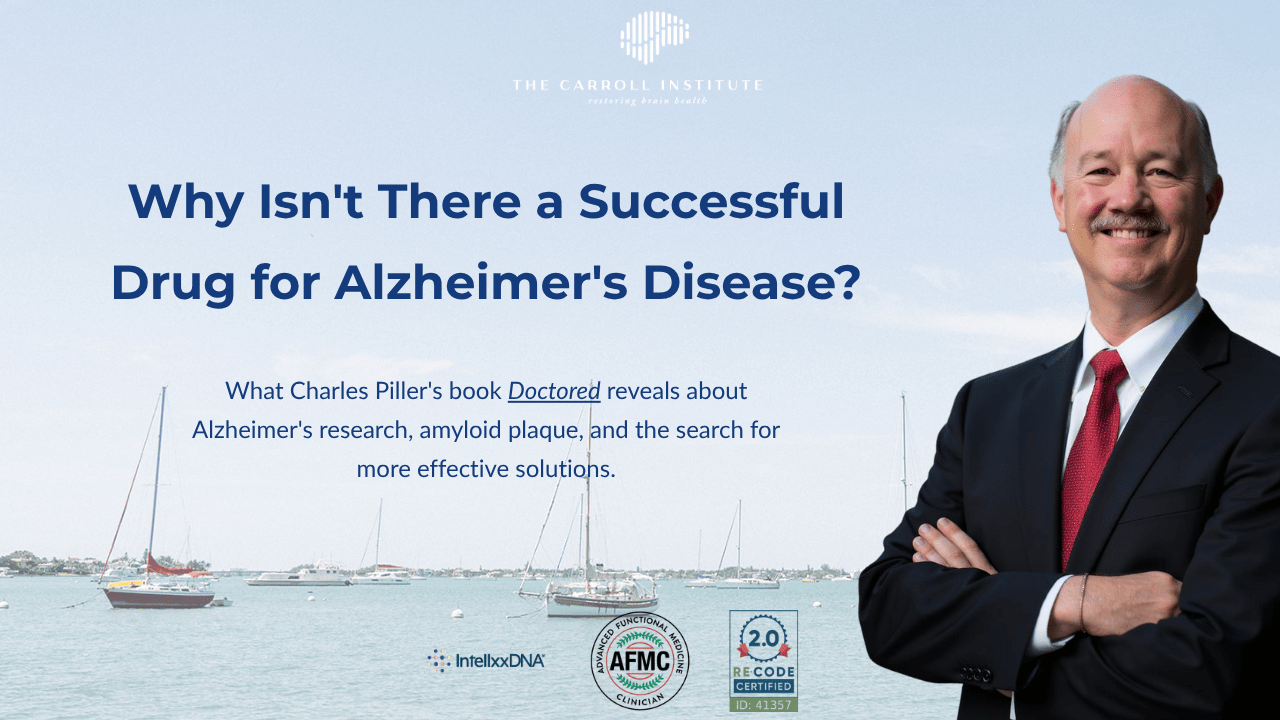
Why Isn’t There a Truly Successful Drug for Alzheimer’s Disease?
What Charles Piller’s Doctored reveals about Alzheimer’s research, amyloid plaque, and the search for more effective solutions.
For more than twenty years, families were told that Alzheimer’s researchers were closing in on a cure.
Billions of dollars were invested. Drug companies built enormous research programs. Much of the field focused on one central idea: amyloid plaque was believed to be the primary cause of Alzheimer’s disease.
The theory seemed simple. If amyloid caused Alzheimer’s, then removing amyloid should stop the disease, restore memory, and lead to a cure.
Unfortunately, that is not what happened.
Even when newer drugs successfully reduced amyloid, they did not restore lost memory or return patients to normal cognitive function. At best, these drugs have shown modest slowing of decline for selected patients.
That raises a difficult question:
Why isn’t there a truly successful drug for Alzheimer’s disease?
What Doctored Revealed
In Doctored: Fraud, Arrogance, and Tragedy in the Quest to Cure Alzheimer’s, investigative journalist Charles Piller examines troubling problems inside Alzheimer’s research.
The book describes allegations of manipulated scientific images, questionable research practices, institutional failures, and incentives that helped keep the amyloid hypothesis at the center of Alzheimer’s research for decades.
This does not mean every amyloid researcher acted improperly. It also does not mean every amyloid study was fraudulent.
However, it does mean that some highly influential research now deserves much more scrutiny than it received at the time.
That matters because scientific research does not happen in a vacuum. When one theory dominates funding, drug development, public messaging, and academic careers, other ideas can be pushed aside.
The Cost of Following One Theory Too Long
The greatest cost may not only be financial.
The greatest cost may be time.
For decades, Alzheimer’s research focused heavily on the question: “How do we remove amyloid?”
Meanwhile, other important questions received less attention.
What role does chronic inflammation play? How much does insulin resistance affect the brain? What about sleep apnea, vascular disease, toxins, nutrient deficiencies, hormonal changes, infections, or chronic stress?
Today, many clinicians believe these questions should have been asked much earlier.
If cognitive decline is a multifactorial condition, then a single-target drug was never likely to solve the whole problem.
Is Amyloid the Cause—or Part of the Brain’s Response?
At The Carroll Institute, we believe amyloid is better understood as part of the story, not the whole story.
Amyloid plaque may be associated with Alzheimer’s disease, but association is not the same as root cause. In many cases, amyloid may represent part of the brain’s response to inflammation, infection, metabolic stress, toxin exposure, or other upstream threats.
Think of a smoke alarm.
If a house is on fire, the alarm is loud and obvious. However, removing the alarm does not put out the fire.
In the same way, removing amyloid may reduce a visible marker of disease without addressing the deeper processes that caused the brain to produce amyloid in the first place.
That may help explain why amyloid-targeting drugs have not produced the recovery families were hoping for.
What Patients Should Learn From This
The lesson is not that science should be rejected.
The lesson is that science must keep questioning its assumptions.
Alzheimer’s disease and other forms of cognitive decline are complex systems problems. They often involve multiple root causes interacting at the same time.
These may include inflammation, insulin resistance, poor sleep, vascular dysfunction, hormonal imbalance, toxin exposure, nutrient deficiencies, chronic infections, stress physiology, and impaired brain network function.
If several of these factors are active, then removing one protein is unlikely to be enough.
That is why a broader model is needed.
Why Precision Medicine Offers a Better Path
Precision Medicine asks a different question.
Instead of asking, “What drug treats Alzheimer’s?” it asks, “What is driving cognitive decline in this person?”
That question changes everything.
A Precision Medicine evaluation looks for the specific contributors affecting an individual brain. Then the care plan can be built around those findings instead of assuming every patient has the same problem.
The EVANTHEA Study supports this broader direction. Rather than focusing on a single target, the study used a personalized Precision Medicine approach for people with Mild Cognitive Impairment and early Alzheimer’s disease.
That kind of research matters because it reflects how cognitive decline actually behaves in real life.
The Carroll Cognitive Method™ Perspective
At The Carroll Institute, we believe the future of Alzheimer’s care requires more than another single-target drug.
The Carroll Cognitive Method™ combines Precision Medicine, Functional Medicine, and Functional Neurology.
Precision Medicine helps identify why the brain is struggling.
Functional Medicine helps address the root causes.
Functional Neurology helps evaluate and strengthen brain function through neuroplasticity-based rehabilitation.
Together, these approaches create a more complete framework for understanding and addressing cognitive decline.
Next Steps
The story described in Doctored is a warning about what can happen when medicine becomes too committed to one explanation for a complex disease.
Alzheimer’s disease is not simply an amyloid problem. It is a multifaceted condition that deserves a multifaceted evaluation.
If you or a loved one has memory loss, Mild Cognitive Impairment, early Alzheimer’s disease, or unexplained cognitive decline, you may have more options than you’ve been told. If you are in Sarasota, the Gulf Coast region, or looking for a deeper evaluation, Book a discovery call to see if this is a fit for you. Or learn more about the Carroll Cognitive Method™ and ReCODE program.
Sources & Citations
- Doctored: Fraud, Arrogance, and Tragedy in the Quest to Cure Alzheimer’s – Simon & Schuster
- Precision Medicine Treatment of Alzheimer’s Disease: Successful Randomized Controlled Trial – Preprints.org
- FDA Approves Treatment for Adults with Alzheimer’s Disease – U.S. Food & Drug Administration
- ReCODE-Based Precision Medicine Framework – The Carroll Institute
- Brain Health and Cognitive Decline Resources – National Institute on Aging
Medically reviewed by Dr. Garland Glenn, DC, PhD, AFMC
Last updated: June 8, 2026
This content is for educational purposes and does not substitute personalized medical advice.
Medically reviewed by Dr. Garland Glenn, DC, PhD, IFM, AFMC
Last updated: June 7, 2026
This content is for educational purposes and does not substitute personalized medical advice.
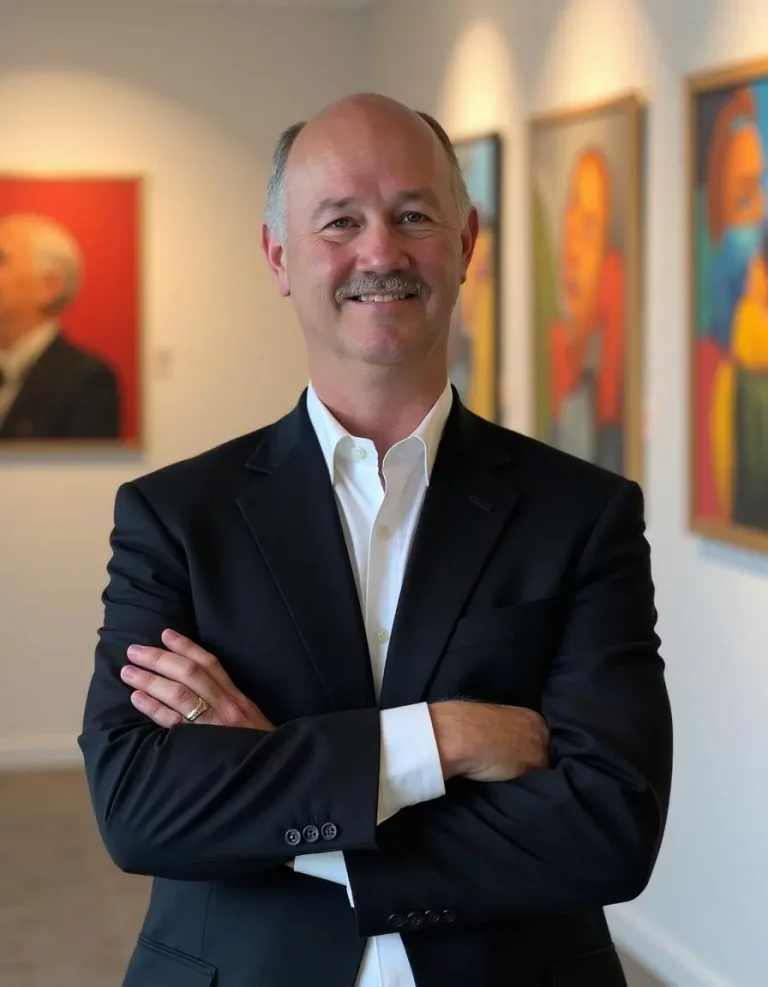
Dr. Garland Glenn, DC, PhD, IFM, AFMC
Founder & Clinical Director, The Carroll Institute — Sarasota, FL
Dr. Garland Glenn is a board-certified chiropractic physician and functional medicine practitioner specializing in cognitive health, neurodegeneration, and root-cause medicine. Certified as an AFMC (Advanced Functional Medicine Clinician) and Institute for Functional Medicine (IFM) trained, he has also completed over 500 hours of advanced training in Functional Neurology under Dr. Ted Carrick, founder of the Carrick Institute.
At The Carroll Institute, Dr. Glenn leads Sarasota’s only ReCODE-certified Functional Neurology program, helping patients reverse or prevent cognitive decline through the Bredesen ReCODE Protocol, neuroplasticity exercises, and personalized functional medicine care.
Learn more about his background and approach at About Dr. Garland Glenn.
– schedule now –
free discovery call
To help you get started, we offer a free 20-minute Discovery Phone Consultation. During this call, you will be able to talk with one of our Certified Brain Health Coaches about what going on with you or your loved one and find out if we can help. Please review our FAQs prior to scheduling your free call. We look forward to talking with you soon and helping you Save Your Brain.
(yes, it’s totally free!)
ReCODE® is a registered program developed by Dr. Dale Bredesen and licensed through Apollo Health. Dr. Garland Glenn is a certified ReCODE practitioner.