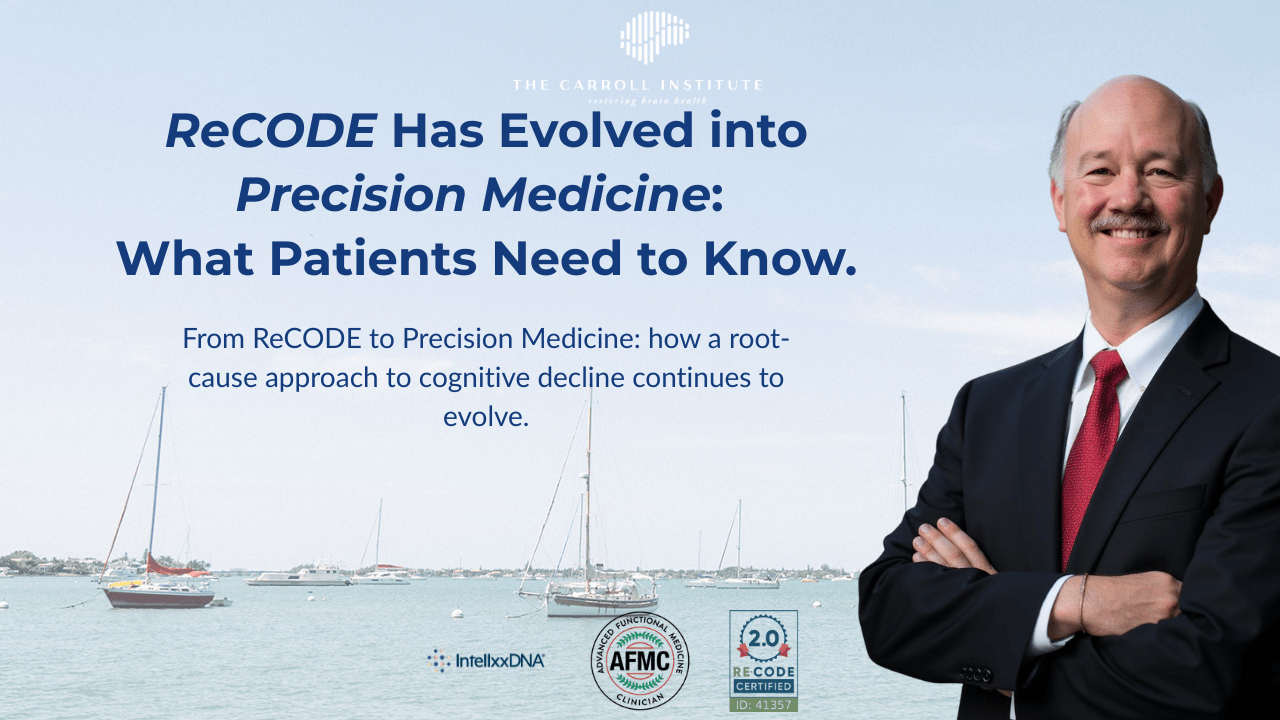
ReCODE Has Evolved Into Precision Medicine: What Patients Need to Know
How ReCODE helped change the conversation around cognitive decline, and why Precision Medicine is the next step forward.
If you have researched cognitive decline, Alzheimer’s disease, or Mild Cognitive Impairment (MCI), you have probably encountered the term ReCODE.
For many years, ReCODE represented one of the most innovative approaches to understanding and addressing cognitive decline. It challenged the idea that Alzheimer’s disease was simply an inevitable consequence of aging and proposed that multiple factors can contribute to declining brain function.
Today, the field has continued to evolve. While the core principles remain similar, many clinicians and researchers now use the broader term Precision Medicine to describe this personalized, systems-based approach to cognitive health.
At The Carroll Institute, we view Precision Medicine as the natural evolution of the ReCODE framework. It keeps the same commitment to identifying root causes while expanding our understanding of the many factors that influence brain health, cognitive performance, and long-term resilience.
Why This Matters
Most patients do not care what a protocol is called. What they care about is whether someone can help them understand what is happening and what can be done about it.
Unfortunately, many people diagnosed with Mild Cognitive Impairment or early Alzheimer’s disease are still told that cognitive decline is simply part of aging, or that there is little they can do beyond monitoring symptoms and considering medications designed to slow decline.
That message is increasingly out of step with what we now understand about the brain.
The most important shift over the past decade has not simply been a new drug. It has been a new way of thinking. Instead of asking only, “What drug matches this diagnosis?” clinicians are increasingly asking, “What factors are affecting this person’s brain?”
That question sits at the center of both ReCODE and Precision Medicine.
Understanding Where ReCODE Came From
When Dr. Dale Bredesen introduced the ReCODE Protocol, it represented a major departure from conventional thinking about Alzheimer’s disease.
Rather than viewing cognitive decline as a single disease process, ReCODE proposed that multiple biological factors may contribute simultaneously. These included inflammation, insulin resistance, hormonal decline, nutrient deficiencies, toxin exposure, sleep disorders, chronic infections, vascular dysfunction, and chronic stress.
This framework resonated with many clinicians because it aligned with what they were seeing in practice. Patients with cognitive decline often had multiple underlying issues affecting brain function. No two patients looked exactly alike.
ReCODE introduced a simple but powerful idea: if multiple factors contribute to cognitive decline, then multiple factors may need to be addressed.
That concept fundamentally changed the conversation.
What ReCODE Got Right
One reason ReCODE remains influential is that many of its foundational principles have stood the test of time.
First, cognitive decline is often multifactorial. Rarely is there one single explanation for why a brain begins to struggle. Most patients have a combination of contributing factors.
Second, early intervention matters. Waiting for symptoms to become severe often reduces the number of available options. The earlier contributing factors are identified, the more opportunities may exist to address them.
Third, personalized care matters. Two patients with the same diagnosis may need completely different treatment strategies because the underlying contributors may be different.
Finally, the brain is connected to the rest of the body. Sleep, metabolism, hormones, inflammation, vascular health, nutrition, environmental exposures, and stress physiology all influence cognitive performance.
These principles remain central to Precision Medicine today.
Why the Field Began Using the Term Precision Medicine
As research expanded, clinicians realized that the underlying principles of ReCODE extended beyond any single protocol.
The term Precision Medicine emerged because it better describes the broader philosophy. Precision Medicine recognizes that every patient is unique, every brain is unique, and every treatment plan should be individualized.
Rather than following a rigid formula, Precision Medicine uses detailed clinical evaluation, advanced testing, emerging research, and personalized intervention strategies to create a plan tailored to the individual.
In many ways, Precision Medicine is not a rejection of ReCODE. It is its maturation.
The core ideas remain intact. However, the framework has become larger, more sophisticated, and more evidence-informed.
The EVANTHEA Study Helped Validate This Evolution
One of the most important developments in recent years was the publication of the EVANTHEA Study.
The significance of EVANTHEA extends beyond its results. It provided randomized controlled trial evidence supporting a Precision Medicine approach for patients with Mild Cognitive Impairment and early Alzheimer’s disease.
Participants underwent comprehensive evaluations designed to identify and address multiple contributors to cognitive decline. These included metabolic dysfunction, inflammation, sleep disorders, hormonal imbalances, nutritional deficiencies, environmental exposures, physical inactivity, and cognitive under-stimulation.
Researchers reported significant improvements in multiple cognitive and functional outcomes. For many clinicians, EVANTHEA represented a milestone because it helped move Precision Medicine from promising theory toward stronger clinical evidence.
Most importantly, the study reinforced a message that patients and families need to hear: the future of cognitive care is likely to be increasingly personalized.
What Precision Medicine Looks Like Today
Modern Precision Medicine continues to investigate many of the same factors identified within the original ReCODE framework. However, today’s evaluations are often broader and more comprehensive.
Metabolic health is often evaluated because blood sugar regulation, insulin resistance, metabolic flexibility, and mitochondrial function all influence brain energy. Inflammation is also important because systemic inflammation, neuroinflammation, immune dysregulation, and inflammatory biomarkers may affect cognitive performance.
Sleep is another major area of investigation. Poor sleep quality, sleep apnea, circadian rhythm disruption, and reduced restorative sleep capacity can all affect memory, attention, and processing speed.
Hormonal health, vascular function, environmental exposures, and nutritional status also matter. Sex hormones, thyroid function, adrenal function, blood flow, endothelial function, oxygen delivery, mold exposure, heavy metals, environmental toxins, micronutrient status, and dietary patterns may all influence the brain.
The goal is not to generate more data for its own sake. The goal is to identify the factors most likely affecting a particular patient’s brain.
Where the Carroll Cognitive Method™ Goes Further
At The Carroll Institute, we embrace the Precision Medicine model because it aligns closely with our clinical philosophy. However, we believe there is another important piece of the puzzle.
Identifying root causes is essential. Addressing root causes is essential. But many patients also need help rebuilding function.
This is where Functional Neurology becomes critically important.
Precision Medicine helps answer: Why is the brain struggling?
Functional Neurology helps answer: How can we help the brain perform better?
Through specialized assessments, we evaluate cognitive processing, eye movements, balance, coordination, attention, and brain network performance. Based on those findings, individualized rehabilitation strategies are developed to stimulate neuroplasticity and strengthen underperforming pathways.
This integration of Precision Medicine, Functional Medicine, and Functional Neurology forms the foundation of the Carroll Cognitive Method™.
Why This Evolution Is Good News for Patients
One of the most encouraging developments in cognitive medicine is that the conversation has shifted.
Years ago, many patients were told, “There is nothing you can do.” Today, a growing number of clinicians recognize that cognitive decline deserves the same root-cause investigation we apply to other complex chronic conditions.
That does not mean every patient will improve in the same way. It does not mean every case is reversible. However, it does mean that many factors affecting brain health can be identified, addressed, and optimized.
For patients and families, that represents a far more hopeful and practical conversation.
Who Should Consider a Precision Medicine Evaluation?
You may benefit from a comprehensive Precision Medicine evaluation if you have Mild Cognitive Impairment, early Alzheimer’s disease, a family history of dementia, persistent brain fog, increasing forgetfulness, trouble concentrating, or concerns that your symptoms are being dismissed as normal aging.
Many patients are surprised to discover previously unidentified contributors affecting cognitive performance. In general, earlier evaluation creates more opportunities than waiting until symptoms become severe.
Next Steps
The most important thing to understand is that ReCODE did not disappear. It evolved.
Its core insights helped pave the way for today’s Precision Medicine approach. At The Carroll Institute, we continue to build upon those principles through the Carroll Cognitive Method™, combining Precision Medicine, Functional Medicine, and Functional Neurology into a comprehensive strategy designed to help patients better understand and support their cognitive health.
If you have been told that memory loss is simply part of getting older, it may be time to ask a different question: Why is this happening?
The answer may be more complex—and more hopeful—than you realize.
If you are in Sarasota, the Gulf Coast region, or looking for a deeper evaluation of memory loss, brain fog, or cognitive performance, Book a discovery call to see if this is a fit for you. Or learn more about our ReCODE and Precision Medicine program.
Sources & Citations
- Precision Medicine Treatment of Alzheimer’s Disease: Successful Randomized Controlled Trial – Preprints.org
- ReCODE-Based Precision Medicine Framework – The Carroll Institute
- The Carroll Institute Precision Medicine Program Overview – The Carroll Institute
- Brain Health And Cognitive Decline Resources – National Institute on Aging
- Alzheimer’s Disease And Mild Cognitive Impairment Information – Alzheimer’s Association
Medically reviewed by Dr. Garland Glenn, DC, PhD, IFM, AFMC
Last updated: June 8, 2026
This content is for educational purposes and does not substitute personalized medical advice.

Dr. Garland Glenn, DC, PhD, IFM, AFMC
Founder & Clinical Director, The Carroll Institute — Sarasota, FL
Dr. Garland Glenn is a board-certified chiropractic physician and functional medicine practitioner specializing in cognitive health, neurodegeneration, and root-cause medicine. Certified as an AFMC (Advanced Functional Medicine Clinician) and Institute for Functional Medicine (IFM) trained, he has also completed over 500 hours of advanced training in Functional Neurology under Dr. Ted Carrick, founder of the Carrick Institute.
At The Carroll Institute, Dr. Glenn leads Sarasota’s only ReCODE-certified Functional Neurology program, helping patients reverse or prevent cognitive decline through the Bredesen ReCODE Protocol, neuroplasticity exercises, and personalized functional medicine care.
Learn more about his background and approach at About Dr. Garland Glenn.
– schedule now –
free discovery call
To help you get started, we offer a free 20-minute Discovery Phone Consultation. During this call, you will be able to talk with one of our Certified Brain Health Coaches about what going on with you or your loved one and find out if we can help. Please review our FAQs prior to scheduling your free call. We look forward to talking with you soon and helping you Save Your Brain.
(yes, it’s totally free!)
ReCODE® is a registered program developed by Dr. Dale Bredesen and licensed through Apollo Health. Dr. Garland Glenn is a certified ReCODE practitioner.