Is Alzheimer’s Disease a Drug Deficiency or a Systems Breakdown?
Why cognitive decline may involve many connected systems, not just one biological target.
For decades, Alzheimer’s research followed a simple idea.
Find the molecule that causes Alzheimer’s disease. Create a drug that targets it. Then the disease should improve.
At first, that idea made sense. However, the results have not matched the hope.
Researchers have spent billions of dollars and decades of effort. Still, drug development has not produced the kind of meaningful recovery that patients and families hoped for.
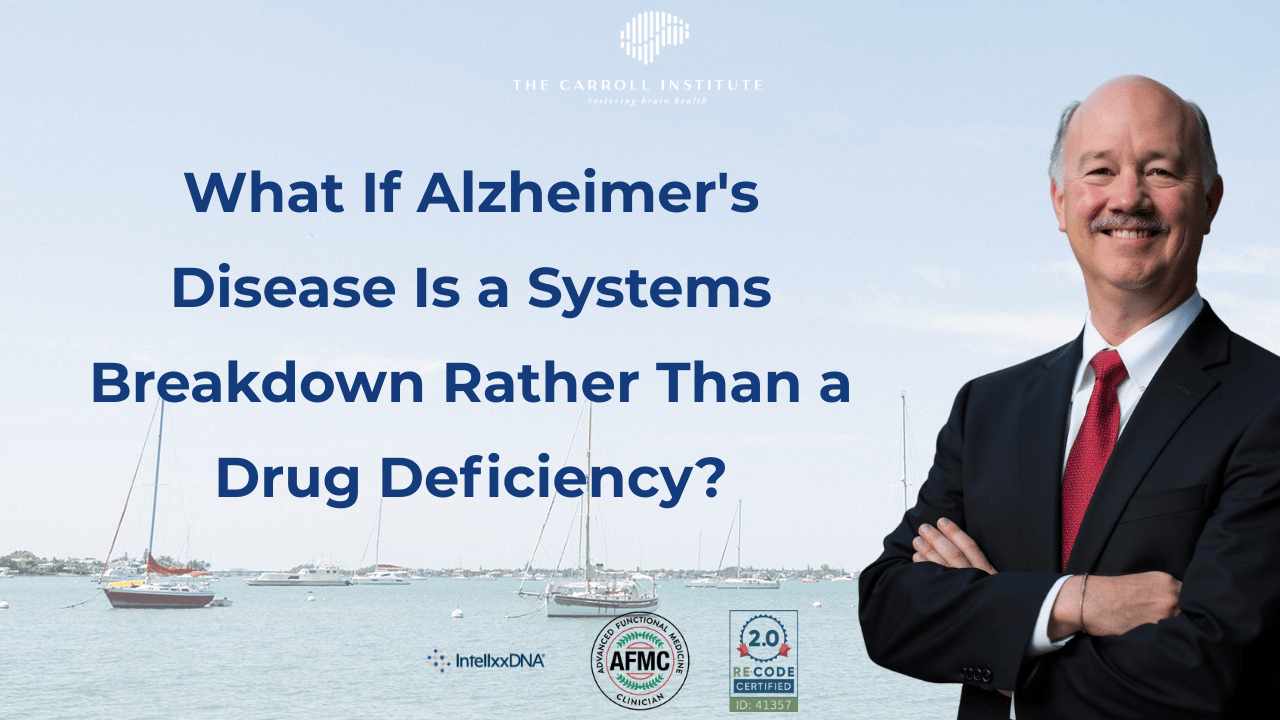
That raises an important question: What if Alzheimer’s disease is not mainly a drug deficiency?
What if Alzheimer’s disease reflects a systems breakdown in the brain?
At The Carroll Institute, we believe this question changes the conversation.
The brain depends on metabolism, inflammation control, sleep, hormones, blood flow, nutrition, environmental safety, and strong neural networks. When several of these systems struggle at the same time, memory and thinking can suffer.
So the answer may not come from one magic bullet. Instead, it may come from understanding and improving the whole system.
Why This Question Matters
Imagine that your car will not start.
One mechanic blames the battery. Another blames the fuel pump. A third blames the starter.
Now imagine that all three are partly right.
The battery is weak. The fuel pump is failing. The electrical system has corrosion.
At that point, you do not have one broken part. You have a system problem.
This same idea helps explain cognitive decline. The brain does not work through one pathway. It relies on many systems working together.
Therefore, when several systems weaken at once, the brain may begin to struggle.
Why Alzheimer's Has Been Viewed as a Drug Problem
For many years, researchers searched for one main cause of Alzheimer’s disease.
The most influential theory focused on amyloid plaque.
The assumption sounded clear. If amyloid causes Alzheimer’s disease, then removing amyloid should improve memory and cognition.
This idea shaped research funding, drug development, clinical trials, and public understanding.
More recently, drugs such as lecanemab and donanemab showed that researchers can remove amyloid from the brain.
However, those results also revealed a major limitation.
Patients generally continued to decline. Their memory did not return. Their cognitive function did not normalize.
In some cases, the disease slowed modestly. But it did not stop.
That outcome suggests Alzheimer’s disease may be much larger than one drug target.
The Problem With the Single-Cause Model
Simple explanations feel attractive.
They are easier to understand. They are easier to study. They are also easier to turn into medications.
However, biology rarely works that way.
Heart disease has many contributors. Diabetes has many contributors. Cancer has many contributors.
So why would Alzheimer’s disease come from only one cause?
Increasingly, researchers recognize that cognitive decline may develop over many years. During that time, metabolism, inflammation, sleep, blood flow, hormones, nutrition, toxins, and brain networks may all interact.
This broader view helps explain why single-target treatments often disappoint families.
The Brain Depends on Multiple Systems
Your brain uses enormous amounts of energy.
Although it represents only a small share of body weight, it needs a constant supply of fuel, oxygen, nutrients, and communication among billions of neurons.
When several support systems weaken, cognitive performance can decline.
Metabolism
The brain needs steady energy to function well.
Insulin resistance, poor glucose use, and mitochondrial dysfunction can reduce brain performance. Some researchers even describe Alzheimer’s disease as involving brain insulin resistance.
Inflammation
Inflammation helps the body heal after injury or infection.
However, chronic inflammation can harm tissues throughout the body, including the brain. Today, neuroinflammation has become one of the most important areas of Alzheimer’s research.
Sleep
Sleep does much more than help you rest.
During sleep, the brain supports memory, repair, hormone balance, and waste clearance. As a result, untreated sleep disorders can strongly affect cognition.
Vascular Health
The brain depends on healthy blood flow.
Even mild circulation problems can affect memory, attention, and processing speed. Healthy blood vessels help protect healthy brain function.
Hormonal Balance
Hormones influence memory, mood, concentration, energy production, and neuroplasticity.
Because of that, hormonal imbalances may contribute to cognitive symptoms that many evaluations overlook.
Nutrition
The brain needs vitamins, minerals, fatty acids, amino acids, and other nutrients.
When key nutrients run low, neurological performance and cognitive health may suffer.
Environmental Exposures
Many conventional memory evaluations do not look closely at environmental exposures.
For some people, mold exposure, heavy metals, air pollution, or chemical toxicants may affect brain health.
Not every patient has these issues. However, some do. Precision Medicine helps identify which factors matter for each person.
Why Drug-Only Thinking Falls Short
This does not mean medications have no role. Some medications may help selected patients.
The problem begins when medication becomes the whole strategy.
A patient may have chronic inflammation, insulin resistance, sleep apnea, hormone imbalance, nutrient deficiencies, vascular disease, and toxic exposures at the same time.
In that situation, a drug aimed at one pathway may leave many contributors untouched.
This may explain why many Alzheimer’s drugs have not produced transformative outcomes.
The issue is not always the medication itself. The issue may be that the disease is larger than the target.
The Brain Is Also a Network
Biology is only part of the story.
Even after we identify contributing factors, the brain still has to function.
Memory depends on networks. Language depends on networks. Attention depends on networks. Executive function depends on networks.
When these networks become inefficient, cognitive performance declines.
This is where Functional Neurology becomes essential.
At The Carroll Institute, we do not only ask why the brain is struggling. We also ask how we can help it perform better.
The Engineering Perspective
Dr. Garland Glenn’s background includes engineering as well as decades of clinical experience.
Engineers learn early that complex systems rarely fail because of one weak part.
Instead, failure often comes from interactions between multiple weak points.
An engineer investigating a failure asks practical questions. Where are the bottlenecks? Which systems interact? What limits performance? Which areas need support?
The Carroll Cognitive Method™ applies that same systems-thinking approach to cognitive decline.
Rather than asking, “What drug does this patient need?” we ask, “What systems are preventing this brain from functioning optimally?”
That question often leads to very different answers.
What the EVANTHEA Study Revealed
The EVANTHEA Study strongly supports a systems-based approach to cognitive decline.
Rather than target one biological pathway, researchers evaluated and addressed several contributors at the same time.
They looked at metabolic health, inflammation, sleep, nutrition, hormones, exercise, stress, and cognitive stimulation.
The results showed meaningful improvements in multiple cognitive measures.
The lesson is clear: complex problems often require comprehensive solutions.
The Carroll Cognitive Method™ Perspective
At The Carroll Institute, we view Alzheimer’s disease as a systems breakdown rather than a single-target disease.
Each patient brings a unique combination of biological and neurological challenges. Therefore, each patient deserves an individualized evaluation.
The Carroll Cognitive Method™ combines Precision Medicine, Functional Medicine, and Functional Neurology.
Precision Medicine helps identify the factors affecting brain health. Functional Medicine helps address those contributors. Functional Neurology helps evaluate and rehabilitate affected brain networks.
Together, these disciplines help us understand why the brain is struggling and how it may function more effectively.
Why This Perspective Gives Families Hope
Many families arrive at our office feeling discouraged.
They have heard, “It’s just aging,” “There’s nothing you can do,” or “Let’s monitor the decline.”
A systems-based perspective creates a different conversation.
If multiple factors contribute to cognitive decline, then multiple opportunities may exist for intervention.
This does not guarantee improvement. However, it does mean many families may have more options than they realize.
Who Should Consider a Systems-Based Evaluation?
You may benefit from a comprehensive evaluation if you have Mild Cognitive Impairment, early Alzheimer’s disease, persistent brain fog, a family history of dementia, increasing forgetfulness, or a desire for a proactive brain health assessment.
Many patients discover contributors that were never fully investigated in previous evaluations.
Next Steps
One of the most important questions in modern cognitive medicine is whether Alzheimer’s disease should be viewed as one disease or as a systems breakdown affecting the brain.
The evidence increasingly supports the systems view.
At The Carroll Institute, we believe patients deserve an approach that reflects the full complexity of the human brain.
The future of cognitive medicine may not come from targeting one molecule. It may come from understanding the whole system.
If you are in Sarasota, the Gulf Coast region, or looking for a deeper evaluation of memory loss, brain fog, or cognitive performance, Book a discovery call to see if this is a fit for you. Or learn more about the Carroll Cognitive Method™ and ReCODE program.
Sources & Citations
- Precision Medicine Treatment of Alzheimer’s Disease: Successful Randomized Controlled Trial – Preprints.org
- Doctored: Fraud, Arrogance, and Tragedy in the Quest to Cure Alzheimer’s – Simon & Schuster
- Alzheimer’s Disease Fact Sheet – National Institute on Aging
- ReCODE-Based Precision Medicine Framework – The Carroll Institute
- The Carroll Institute Precision Medicine Program Overview – The Carroll Institute
Medically reviewed by Dr. Garland Glenn, DC, PhD, IFM, AFMC
Last updated: June 11, 2026
This content is for educational purposes and does not substitute personalized medical advice.

Dr. Garland Glenn, DC, PhD, IFM, AFMC
Founder & Clinical Director, The Carroll Institute — Sarasota, FL
Dr. Garland Glenn is a board-certified chiropractic physician and functional medicine practitioner specializing in cognitive health, neurodegeneration, and root-cause medicine. Certified as an AFMC (Advanced Functional Medicine Clinician) and Institute for Functional Medicine (IFM) trained, he has also completed over 500 hours of advanced training in Functional Neurology under Dr. Ted Carrick, founder of the Carrick Institute.
At The Carroll Institute, Dr. Glenn leads Sarasota’s only ReCODE-certified Functional Neurology program, helping patients reverse or prevent cognitive decline through the Bredesen ReCODE Protocol, neuroplasticity exercises, and personalized functional medicine care.
Learn more about his background and approach at About Dr. Garland Glenn.
– schedule now –
free discovery call
To help you get started, we offer a free 20-minute Discovery Phone Consultation. During this call, you will be able to talk with one of our Certified Brain Health Coaches about what going on with you or your loved one and find out if we can help. Please review our FAQs prior to scheduling your free call. We look forward to talking with you soon and helping you Save Your Brain.
(yes, it’s totally free!)
ReCODE® is a registered program developed by Dr. Dale Bredesen and licensed through Apollo Health. Dr. Garland Glenn is a certified ReCODE practitioner.